
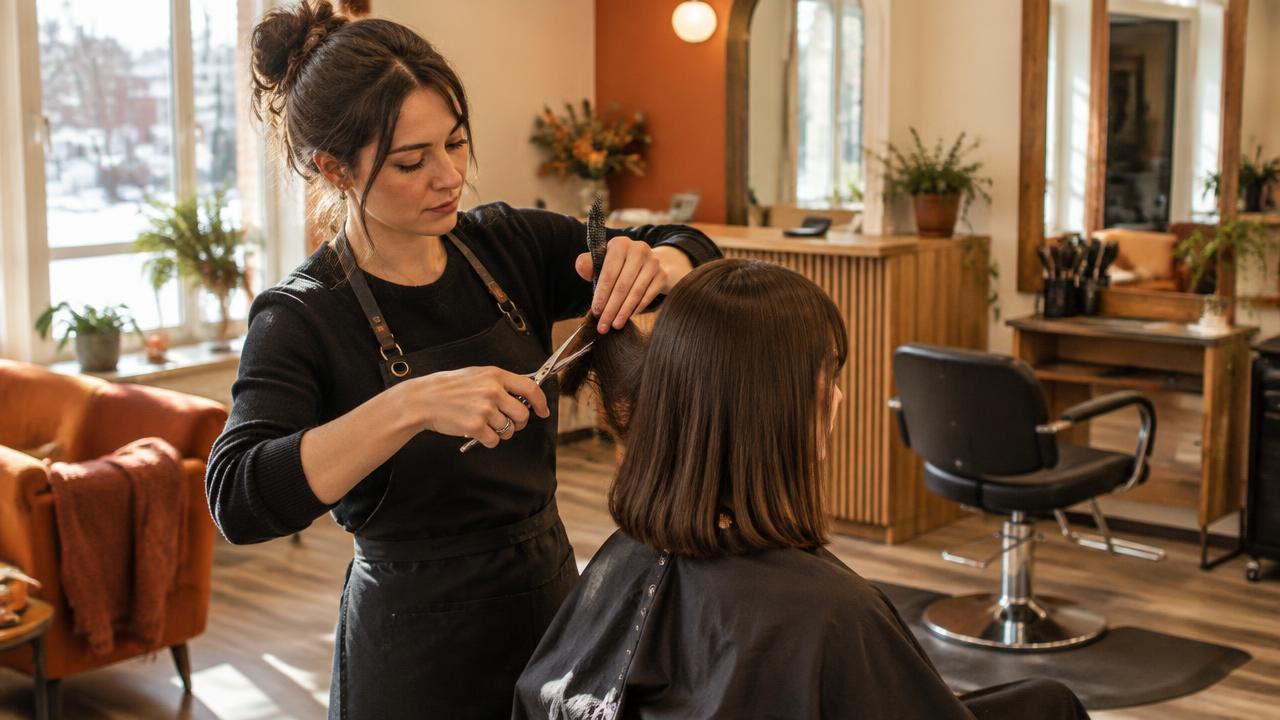
Saturday, 10:15 a.m. You have a colour processing, a cut in progress and a client waiting at the shampoo bowl. The salon phone rings once, twice, then goes quiet. You have scissors in one hand and a client's hair in the other: you can't pick up, and that's exactly how it should be. The person in front of you deserves your full attention. But at the end of the day, looking at the screen, you see three missed calls from numbers you don't recognize. Maybe a new client who wanted an updo for a wedding, maybe a regular who wanted to move their appointment. In a salon, missed calls come with the job. This guide offers simple ways to stop letting those bookings slip away, without ever leaving the client who's sitting in your chair.
Why Hair Salons Miss So Many Calls
Hairdressing is a job where both hands are busy almost all the time. During a cut, a colour, a balayage or a blowout, stopping to answer the phone breaks the rhythm and makes the client feel like they come second. Most stylists choose to let it ring, and that's the right instinct.
Many salons in Quebec are small teams, sometimes a single person who is self-employed or rents a chair. There isn't always someone at the front desk, and when there is, that person also handles payments, shampoos, product sales and tidying up between clients. The phone naturally comes after the person who is actually there.
Finally, clients often call at the very moments when you're busiest: at lunch, late afternoon, Thursday evening and Saturday morning. Those are your peak slots. Missing calls at those times has nothing to do with poor organization: it's proof that your salon is busy.
What the Client Goes Through When Nobody Answers
The person calling a salon often has a specific reason and a deadline. They want a cut before a job interview, a colour before the holidays, a style for a graduation ball or a family photo. They may also simply need to move their appointment because daycare just called.
When nobody answers and they reach voicemail, they hesitate. Some leave a message and wait patiently. Others hang up, open Google Maps and call the next salon on the list, especially if they're looking for a first appointment and don't know you yet. It's not a lack of loyalty: they just want to know quickly whether they'll get a spot.
For a regular client, an unanswered call is rarely a big deal. For a new client, though, it's often the only chance you'll get to make a good first impression. The first contact matters, even if it doesn't happen live on the phone.
Running the Numbers for Your Salon
There's no universal figure for lost bookings in hairdressing, and every salon is different. The most useful thing is to do your own exercise based on your call history. Take a normal week, neither the quietest nor the week before Christmas, and look at missed calls from numbers that aren't already in your client list.
Here's an example calculation, just to illustrate the method. If your salon misses 5 calls from new clients per week and 2 of them end up booking elsewhere, with an average service of $90, you're letting $180 a week slip away. And a satisfied new client often comes back several times a year: if she returns 5 times, each lost client represents $450 over a year. Your numbers will be different, but the order of magnitude will help you decide whether it's worth acting.
- Count missed calls from unknown numbers during a typical week.
- Estimate how many of those people never called back or texted.
- Calculate the average value of a service (cut, colour, styling).
- Estimate how many times a year a loyal client comes back to the salon.
- Multiply it all to get the yearly value of a lost client.
The Limits of Voicemail and End-of-Day Callbacks
Voicemail has the advantage of existing, but it asks a lot of both sides. The client has to remember to leave their name, number, the service they want and their availability. Many people just say "Call me back," or hang up without saying anything.
On your end, you have to listen to messages between clients, jot the details on a scrap of paper and call back. Often the person doesn't answer because they're at work. You play phone tag for two or three days, and in the meantime the slot they wanted has sometimes been taken by someone else.
Texting solves a good part of that problem. The client can write when it suits them, even discreetly at the office. You can reply while a colour is processing or at the end of a service. Nobody needs to be free at the same moment for the booking to move forward.
Automatic Text After a Missed Call, Applied to the Salon
The idea is simple. When nobody can answer, the salon's line forwards the call using conditional call forwarding, a feature offered by most phone providers in Canada. Within seconds, the caller receives a text message sent from the salon's number, the very number they just dialled.
The message confirms that their call was seen, that the team is with clients, and invites them to write what they need. While you calmly finish your cut, the client is already telling you the service they want and their availability. When you pick up your phone between clients, the information is there, ready to handle.
That's exactly what Alloia does: an automatic text after every missed call, sent from your current number, then the rest of the conversation by text in a single inbox. You keep the number on your sign, your Google profile, Instagram and your business cards. The tool doesn't replace anyone: you or your team reply to clients and confirm bookings, simply when you're able to.
Sample Texts for Hair Salons
A good automatic text is short, warm and reflects your salon's personality. A neighbourhood salon can afford a more casual tone, while a high-end salon will keep a more polished style. In every case, address new clients politely and clearly name the salon in the very first line.
Also announce a realistic reply time. If you're alone behind the chair all day, promising a reply within five minutes puts needless pressure on you. "Between appointments" or "by the end of the day" is often more honest.
- General: "Hello, this is [Name] Salon! We're with clients and couldn't pick up. Text us the service you'd like and your availability, and we'll get back to you between appointments."
- New client: "Thanks for calling! For a first visit, let us know the service you'd like (cut, colour, highlights, etc.) and your hair length. We'll suggest a time slot."
- Change or cancellation: "Hello! If you need to move or cancel your appointment, text us here with your name and the scheduled date. We'll confirm the change."
- Special event: "Thanks for calling! For a wedding, prom or event hairstyle, let us know the date, the number of people and the time you need to be ready."
- Salon closed: "Good evening, the salon is closed for the day. Leave us a text and we'll reply as soon as we open tomorrow."
Handling Bookings by Text Without Spending Your Day on It
Texting shouldn't become one more distraction during your services. The goal is to give you back control of your time. Many stylists set aside small, fixed moments to reply: while a colour is processing, between clients, at lunch and at closing.
Keep your schedule handy when you reply, whether it's on paper or online. Suggest two or three specific slots rather than asking "When are you available?", which avoids back-and-forth. Once the booking is confirmed, enter it right away in your usual schedule to avoid double bookings.
If you work with others, a shared inbox changes a lot. The whole team sees the same history, nobody replies twice to the same client, and a request doesn't get stuck on the personal phone of a colleague who's off on Tuesdays.
- Set specific times during the day to reply to texts.
- Always suggest two or three concrete time slots.
- Ask for the desired service from the start so you block the right amount of time.
- Confirm the date, time, service and stylist's name in writing.
- Enter the booking in your usual schedule right away.
Small Touches That Keep Clients Coming Back
Texting isn't only useful for catching new bookings. Used well, it strengthens your bond with regular clients. A clear confirmation the day before, a note reminding them to arrive with dry hair if that's how you work, or a tip about parking: these are details that make the experience more pleasant.
For longer or more expensive services, like a balayage or a full colour, texting also lets you ask the right questions before the appointment. What's the current colour? Has there been a recent colour treatment? A photo of the cut they want? These answers help you plan the right amount of time and avoid surprises in the chair.
Still, respect your clients' time. Write when it's useful, not to fill space. And if someone tells you they prefer the phone, make a note of it and respect their choice.
Staying Professional and Following the Rules
Even though texting is a more relaxed channel, your clients see it as an extension of your salon. Careful spelling, a warm tone and a reply within a reasonable time build trust before the person even walks through the door.
On the rules side, replying to someone who just called you about a booking is a normal communication with a client. However, if you ever want to send promotions by text, Canada's Anti-Spam Legislation (CASL) requires, among other things, consent and a simple way to unsubscribe. In Quebec, Law 25 also governs the protection of the personal information you collect. For specific questions, a legal advisor remains your best reference.
- Introduce yourself with the salon's name, and ideally your first name.
- Write in complete sentences, without overly casual abbreviations with a new client.
- Don't ask for unnecessary personal information by text.
- Keep booking conversations separate from promotional messages.
- Always respect unsubscribe requests: if someone texts STOP, you stop texting them.
FAQ: Common Questions from Hair Salons
Do I need to change my salon's number? No. The automatic text is sent from your current number. Your clients keep dialling the number they know, the one on your sign, your Google profile and your social media.
I already have an online booking system. Is this still useful? Yes. Many people still call, especially for a first visit, a specific service or a last-minute change. Your text can also mention the address of your online booking page, for those who prefer to book themselves.
Does the text book appointments for me? No. The text opens the conversation and gathers basic information. You or your team suggest a slot and confirm the booking, just as you already do.
Will my clients find it impersonal? Most appreciate a quick reply rather than waiting with no news. A well-written message in the salon's name is reassuring, and you take over the rest of the conversation.
What happens if I answer the call? Nothing changes: if someone picks up, the call goes ahead as usual. The text is only sent when the call couldn't be answered.
Do people calling from a landline receive the text? Generally, no. The call stays in your history, and the best thing to do is call the person back as soon as possible.