
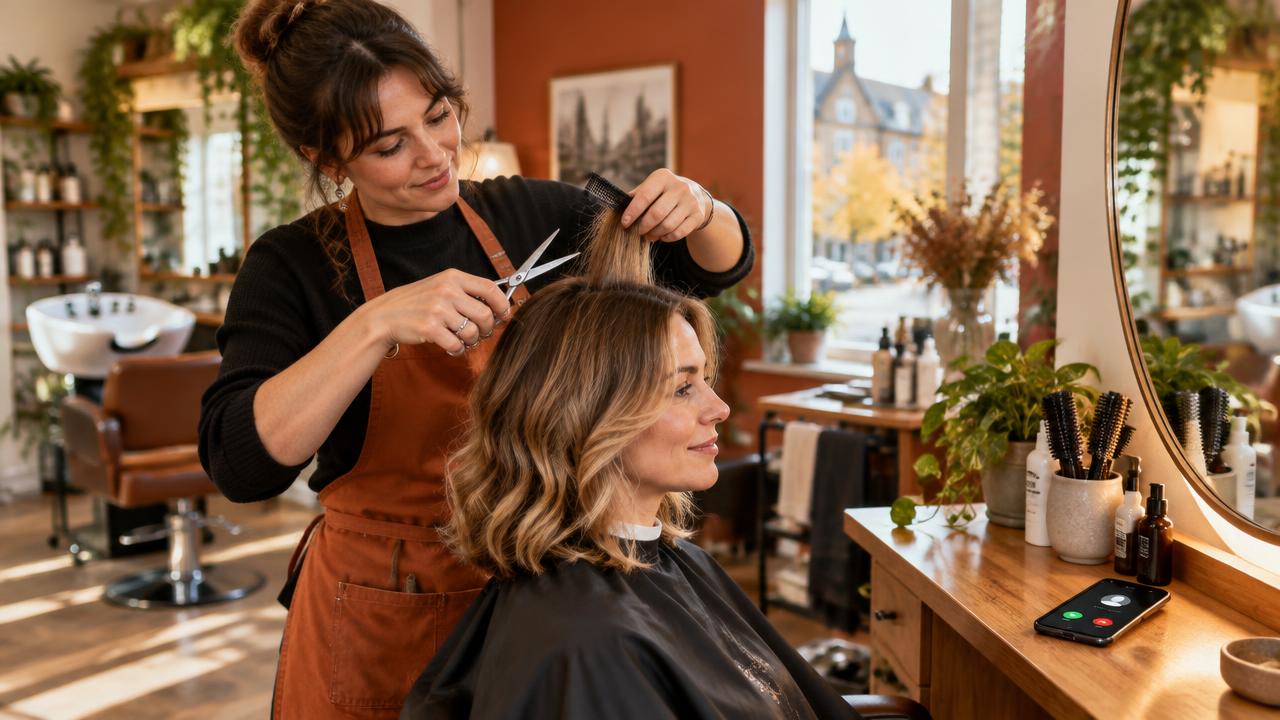
It's 2 p.m., you're in the middle of a job with a client, and your phone buzzes in your pocket. You can't pick up, and that's normal: missed calls come with the job. What makes the difference isn't answering every call, it's what the caller receives in the seconds that follow. A clear, friendly and useful text shows them their call mattered and gives them a simple way to keep the conversation going. In this guide, you'll find 15 text message templates to send after a missed call, organized by situation and type of business, along with tips to adapt them to your tone, respect character limits and follow Canadian best practices. Copy them, tweak them, make them your own.
What makes a good missed call text
A good follow-up text doesn't need to be long or clever. It simply needs to answer the three questions on the mind of someone whose call just went unanswered: did I call the right place, did they see my call, and what do I do now? If your message answers those three questions in two or three sentences, it's doing its job.
The first sentence identifies your business. Your customer may have called three companies in five minutes, and a text that starts with "Hi, this is Tremblay Renovations" saves them from wondering who's writing. The second sentence acknowledges the call without over-apologizing. The third offers a concrete next step: describe the need, share an address, give availability or simply reply to the text.
Tone matters as much as content. For a first contact, a polite and professional tone is the safe choice, especially when you don't know who's on the other end. A warm word ("Thanks for calling!") and a signature with your first name make the message human, even when it's sent automatically. The goal isn't to sound like a big corporation, it's to sound like you.
Finally, a good text never promises something you can't deliver. Writing "we'll call you back in 5 minutes" when you're on a roof until 5 p.m. sets up disappointment. Go with "we'll get back to you as soon as we can" or "on our next break", and then actually follow up.
Before you copy a template: length, accents and compliance
A standard text (one "segment") holds up to 160 characters when it uses the GSM alphabet, the basic character set of mobile networks. Some accented letters, like é, è, à and ù, are part of that alphabet. Others, like ê, â, î, ô or û, along with emojis, are not. As soon as one of those characters appears, the whole message switches to a different encoding (UCS-2) and the limit for one segment drops to 70 characters.
In practice, a 150-character message containing a single "ê" will be split into several segments. Your customer won't notice anything on screen, but each segment counts toward your texting plan. This matters most for bilingual businesses writing in French. The fix isn't to drop accents (customers would notice), it's to stay brief and rephrase when it's easy.
On the compliance side, Canada's Anti-Spam Legislation (CASL) governs commercial electronic messages. A text that directly responds to someone's call is transactional in nature, but a few habits remain essential. These best practices are not legal advice, and a full article on CASL is coming to this blog.
Habits to keep with every template:
- Always identify your business in the message.
- Stay on the topic of the call: no promotions, no discounts, no newsletters.
- Honour a STOP reply immediately: that person should not receive any more texts.
- Never ask for sensitive information by text (social insurance number, credit card, health details).
- Keep the message under 160 characters when possible, or under 70 if it contains characters outside the GSM alphabet.
Templates 1 to 4: all-purpose texts
These four templates work for almost any business. They're a good starting point if you want a simple message that works at any time, or if you're preparing versions for business hours, evenings and weekends. Replace the items in brackets with your own details.
Notice that none of these templates opens with a heavy apology. A simple "sorry we missed your call" is plenty: your customer knows you're working, and what they really want is to know how to get an answer.
- Template 1, general: "Hi, this is [Business]. Sorry we missed your call! How can we help? Reply to this text and we'll get back to you shortly."
- Template 2, busy with a client: "Hi, this is [First name] from [Business]. I'm with a client right now. Text me your question here and I'll reply as soon as I'm done."
- Template 3, after hours: "Good evening, this is [Business]. Our office is closed for the day. Text us your request and we'll reply tomorrow morning."
- Template 4, weekend: "Hi, this is [Business]. We're closed for the weekend. Text us your request here and it will be a priority Monday morning."
Templates 5 to 8: trades and home services
Electricians, plumbers, renovation contractors, mechanics, landscapers, movers: you spend your days with your hands full, often in noise or up a ladder. Your follow-up text should go straight for the information you'll need to respond efficiently when you have a minute: the type of work, the city, the urgency.
A specific question gets better answers than a vague "how can we help?". When you pick up your phone again, you'll already know if the request is a breakdown, a quote or a small fix, and you can prioritize without calling everyone back blind.
- Template 5, job site (renovation, electrical): "Hi, this is [First name] from [Business]. I'm on a job site. What type of work, and in which city? I'll reply on my next break."
- Template 6, emergencies (plumbing, heating): "Hi, this is [Business]. We're out on a call. If it's urgent, text URGENT with your address and we'll call you back as soon as we can."
- Template 7, auto shop: "Hi, this is [Name] Garage. We're working on a vehicle. What make, what year and what's the problem? We'll get back to you with an opening."
- Template 8, quote request (landscaping, moving): "Hi, this is [Business]. Thanks for calling! To prepare your quote, send us your address and a short description of the project."
Templates 9 to 11: health, beauty and wellness
At a clinic, a salon or in a treatment room, you simply can't interrupt a session to answer the phone. Your clients understand that perfectly. Here, the text reassures them and collects the essentials so you can offer them a time that works.
A word of caution for health professionals: text messaging isn't the place to exchange medical details. Ask for the person's name and the general reason for the call, then keep clinical questions for the appointment or an appropriate channel. It's more respectful of your patients' privacy, and consistent with the spirit of Quebec's Law 25 and Canadian privacy rules.
- Template 9, clinic (physiotherapy, dental, chiropractic): "Hi, this is [Clinic name]. We're with a patient. Text us your name and the reason for your call, and we'll reply between appointments."
- Template 10, hair or beauty salon: "Hi, this is [Salon]. Our hands are busy with a client! What service would you like and which days work for you? We'll get back to you soon."
- Template 11, massage therapy or treatments: "Hi, this is [First name], massage therapist. I'm in a session. Text me your availability and I'll reply when the treatment is done."
Templates 12 to 15: professionals, real estate and retail
Accountants, lawyers, brokers, restaurant owners, retailers: your first contact sets the tone for the whole relationship. The text should be a bit more formal while staying welcoming. Its main purpose is to understand the reason for the call so the right person answers, at the right time, with the right information.
The last template shows how to add a link. A link to your website, your request form or the online booking tool you already use can help the person move forward without waiting. Keep it short and check that it opens properly on a phone.
- Template 12, firm (accountant, lawyer, notary): "Hi, this is [Firm name]. We're in a meeting. Briefly tell us what your call is about and the best time to reach you."
- Template 13, real estate broker: "Hi, this is [First name], real estate broker. I'm at a showing. Which property or neighbourhood interests you? I'll reply as soon as I can."
- Template 14, restaurant or caterer: "Hi, this is [Restaurant]. We're in the middle of service. For a reservation or an event, text us the date, time and number of guests."
- Template 15, with a link: "Hi, this is [Business]. Sorry we missed your call. Reply to this text or check out our services here: [link to your website]."
Adapting a template to your business
A template is a starting point, not a sacred text. Read it out loud: if it doesn't sound like the way you talk to your customers, change it. An electrician in Saguenay and a physiotherapy clinic in Laval don't have the same tone, and that's perfectly fine. Your regular customers will recognize your way of speaking.
Think about the time of day, too. The same text can seem odd if it arrives at 9 p.m. saying "we'll get back to you within the hour". If you have set business hours, prepare at least two versions: one for daytime, one for evenings and weekends. Your customers will know right away what to expect.
Here are a few simple adjustments that make a real difference:
- Sign with your first name if you're self-employed or a small team: the message instantly feels more personal.
- Ask one question at a time: people reply more easily.
- Use the words of your trade that customers know (quote, estimate, consultation, appointment).
- Avoid all caps and strings of exclamation marks, which make the tone feel pushy.
- Run a test: call your own number from another phone, don't answer, and read the text as if you were a customer.
How Alloia sends these texts from your current number
Writing a good template is half the work. The other half is sending it every single time, within seconds, even when you're on a job site or in the middle of a treatment. That's exactly what Alloia does: when a call goes unanswered, the caller automatically receives your text, from the number they just dialled. The connection is made through conditional call forwarding, a feature offered by most phone providers in Canada.
You write your message once, in your own words, using any of the templates above. Then, if the person replies, the conversation continues by text and you find it all in one place, ready to pick up when you have a moment. You stay in control of every reply: Alloia doesn't replace your judgment or the way you talk to your customers, it simply makes sure no call goes without a follow-up.
To avoid duplicates, only one automatic text is sent per missed call, and STOP replies are honoured. Your customer gets a quick, polite response without feeling pressured. And you pick up the conversation when it suits you, with the information you need already in hand.
Common mistakes to avoid
Most mistakes come from good intentions: wanting to say everything in a single text. But a six-line message reads poorly on a lock screen and uses more segments. The follow-up text opens the conversation, it doesn't replace it.
Here are the most common pitfalls and how to avoid them:
- Forgetting to name the business: the person doesn't know who's texting and may think it's spam.
- Adding a promotion: a missed call follow-up is not an ad, and mixing the two can raise CASL issues.
- Promising an unrealistic delay: "as soon as we can" beats a 5-minute callback that never comes.
- Never reading the replies: an automatic text with no human follow-up creates more frustration than no text at all.
- Copying a template without proofreading: a forgotten "[Business]" in brackets makes a poor impression.
- Writing in shorthand ("thx", "pls", "u"): it may feel friendly, but it hurts your professional image.
Frequently asked questions
What's the ideal length for a missed call text? Aim for 100 to 160 characters. That's enough to identify yourself, acknowledge the call and suggest a next step, while staying readable at a glance. If your message contains characters like ê, â or ô, keep in mind that the limit for one segment drops to 70 characters.
Should the tone be formal or casual? For a first automatic contact, a polite and professional tone is the safest choice. Nothing stops you from relaxing the tone later in the conversation if your customer does so and it fits your business's style. In French, that means using "vous" first.
Can I have different messages for daytime and evenings? It's a good practice: one message for business hours and another for evenings and weekends avoids promising response times you can't keep. Build your two versions from templates 1, 3 and 4.
Can I include a link? Yes, a link to your website, your request form or the online booking tool you already use can be helpful. Keep it short, make sure it works on a phone, and make sure the person can also simply reply to the text.
Does it work if the person calls from a landline? A landline generally can't receive texts. In that case, the call stays in your history and it's best to call the person back as soon as you can.
What should I do if a customer replies STOP? Respect their choice right away: they should not receive any more texts from you. If they call you back later, you can of course answer them by phone.