
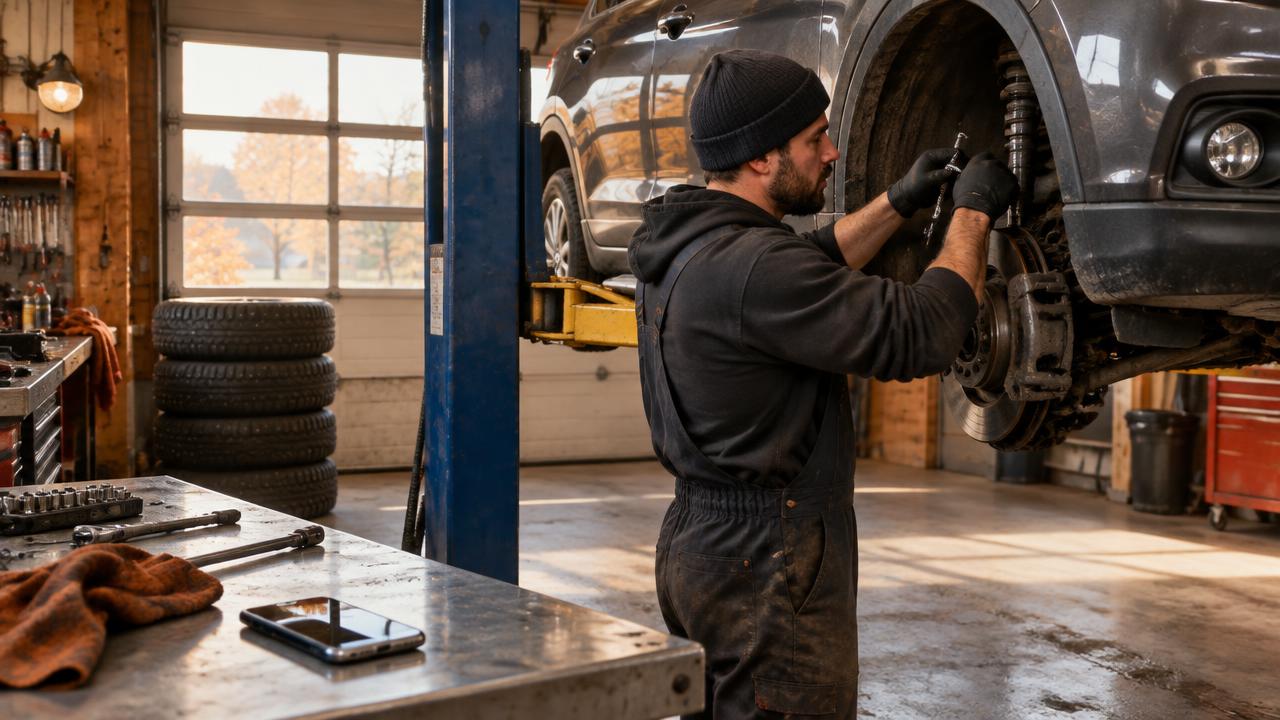
It's 10:15 a.m. on a Tuesday in late October. You're lying on a creeper under a pickup truck, hands black with oil, working on a brake caliper that refuses to budge. In the office, the phone rings. Once, twice, then it stops. When you roll out from under the vehicle twenty minutes later, you see three missed calls, two of them from numbers you don't recognize. A customer who wants winter tires put on? A driver with a check engine light looking for a shop she can trust near home? There's no way to know. In a garage, missed calls come with the job. You can't drop a torque wrench mid-tightening to run to the phone, and nobody expects you to. This guide offers simple ways to stay in touch with every person who calls, without compromising the quality of your work or your already packed days.
Why Auto Repair Shops Miss So Many Calls
Auto repair is physical work that requires focus. When you're diagnosing a noise in a suspension, bleeding brakes or working under a vehicle on the lift, you're simply not in a position to answer. That's normal, and it's even a safety issue: a distracted mechanic is a mechanic who risks getting hurt or skipping an important step.
In many small independent shops, there's no one dedicated to the front desk all day. The owner is often also the lead mechanic, the one who writes estimates, orders parts and hands back keys at the end of the day. When he's in the bay, the counter is empty. Even in shops with a service advisor at the counter, that person is regularly busy with a walk-in customer, on the phone with a parts supplier or writing up an invoice.
There are also moments when everyone calls at once. At opening, customers want to know if their car is ready. At lunch, people call from the office. And when tire season arrives, the phone becomes almost impossible to keep up with. Missed calls piling up are not a sign of poor management: they're the reality of a busy shop.
Tire Season: When the Phone Never Stops Ringing
In Quebec, winter tires are mandatory on passenger vehicles from December 1 to March 15, according to the Government of Quebec. As a result, from the first cold mornings of October and November, a large share of customers want to book at the same time. In spring, the same thing happens in reverse. These are two periods when every call counts, but when you have the least time to answer.
During those weeks, many shops hear from customers they don't know yet: people who just moved to the neighbourhood, others whose usual garage is fully booked, others simply shopping around for a place that can take them quickly. These people often call two or three shops in a row. The one that responds first, one way or another, has a good chance of getting the booking.
- Prepare your tire season message in advance (wait times, availability, tire storage).
- Say clearly whether you're taking new customers during the rush.
- Ask for the useful details in the first exchange: type of vehicle, whether they already have tires, whether they're stored with you.
- Set aside a short window each day to reply to requests, rather than interrupting work in the bay for every call.
What the Caller Is Going Through
Put yourself in your customer's shoes for a moment. They hear a grinding noise every time they brake, or their check engine light just came on on the highway. They're a little worried, they need their vehicle to get to work and they don't know if it's serious. Above all, they want to know one thing: can you take them, and when?
When they reach voicemail, they hesitate. Some leave a complete message with their name, number and a description of the problem. Many others hang up without a word and call the next shop on Google Maps. It's not a lack of loyalty: they're looking for a quick answer because their car is often how they earn a living.
So the goal isn't to answer every call live, which is impossible when both hands are in an engine. The goal is to quickly confirm that their call was seen and that someone from the shop will get back to them.
Running the Numbers for Your Own Shop
Rather than relying on general statistics, take a few minutes to run the numbers with your own data. Look at your business line's call history for an ordinary week and count the missed calls from numbers that aren't already in your customer list.
Here's an example calculation, just to illustrate the method. If your shop misses 5 calls from new customers per week and only one of them ends up going elsewhere, with an average bill of $450, that's $450 a week. Over 48 weeks, that's about $21,600. And a good repair shop customer often comes back for years, for maintenance, tires and repairs. Your numbers will be different, but the exercise gives you an order of magnitude that reflects your reality.
- Count missed calls from unknown numbers during a typical week.
- Estimate how many of those people never called back.
- Calculate your average bill for a new customer.
- Multiply the number of lost customers by that average bill.
- Think about long-term value too: a happy customer comes back for oil changes and tires every season.
Why Texting Works So Well for a Repair Shop
A phone call requires two people to be available at the same moment. But you're rarely free when your customer is, and the reverse is true too. You end up calling each other back all day, leaving messages that only say "call me back." Each attempt eats a few minutes and forces you to wash your hands, leave the bay and find the right file.
Texting solves much of that problem. Your customer can write when it suits them, even discreetly at work, and you can reply between two vehicles in a few seconds. They can also send you a photo of the warning light on the dashboard, the tire that's losing air or the puddle under their car. For you, that's often more useful than a description over the phone.
Texting also leaves a written record. The year, model, mileage, described problem and when the customer can drop by all stay in the conversation. Nobody has to scribble those details on an oil-stained scrap of paper that will get lost on the workbench.
Automatic Text After a Missed Call: How It Works
The idea is simple. When nobody can answer, your line forwards the call using conditional call forwarding, a feature offered by most phone providers in Canada. A few seconds later, the caller receives a text message sent from your shop's number, the very number they just dialled.
The message confirms that their call was seen, that the team is currently in the bay, and invites them to write what they need. While you calmly finish your work, your customer is already leaving you the useful details. When you roll out from under the vehicle, the request is waiting for you, clear and complete.
That's exactly what Alloia does: an automatic text after every missed call, sent from your current number, then the rest of the conversation by text in a single inbox. You keep the number on your sign, your Google profile and your invoices. The tool doesn't replace anyone at the counter: you and your team are the ones replying to customers, giving estimates and setting appointments, simply when you're able to.
Sample Texts for Repair Shops and Mechanics
A good automatic text should be short, warm and clear. It should reassure the person, tell them what's going on and give them a simple reason to text you rather than call somewhere else. No need to overdo it: the goal is to open the conversation.
Announce a realistic reply time. If you usually answer messages at lunch and at the end of the day, say so. A customer prefers an honest promise to an "immediate" reply that never comes.
- General: "Hi, this is [Name] Auto. We're under a vehicle and couldn't pick up. Text us what you need and we'll get back to you as soon as possible."
- New customer: "Thanks for calling! To help you faster, let us know the year and model of your vehicle and what's going on. A photo of the warning light or the problem is welcome."
- Tire season: "Hi! It's tire season and we're very busy. Let us know whether you already have your tires or they're stored with us, and your availability. We'll suggest a time slot quickly."
- Existing customer: "Hi! If you're checking whether your vehicle is ready, text us here and we'll update you as soon as we're out of the bay."
- After hours: "Good evening, the shop is closed for the day. Leave us a text and we'll reply as soon as we open tomorrow morning."
- Safety reminder: "We'll get back to you shortly. If your brakes stop responding or you smell something burning, avoid driving and have the vehicle towed."
Organizing the Counter and the Bay Around Texts
Texting shouldn't become one more distraction while you work. The idea is to take back control of your time. Many shops set aside short, fixed windows to reply to messages: early morning, at lunch and late afternoon. Between those moments, work in the bay comes first, guilt-free.
If there are several of you, decide clearly who handles new requests. With a single shared inbox, the owner, the service advisor and the mechanics all see the same conversation history. Nobody replies twice to the same customer, and no request gets lost because it stayed on the personal phone of someone who's off that day.
For mechanics who work alone or do mobile repairs, it's even more valuable. You can reply from your truck between two service calls, instead of spending your evening calling everyone back.
- Set two or three moments a day to reply to texts.
- Keep ready-made replies for frequent questions (business hours, wait times, tire storage).
- Always confirm the date, time and planned work in writing.
- Let the customer know by text when their vehicle is ready, with the approximate amount if you have it.
Best Practices for Staying Professional by Text
Texting is more informal than email, but your customer sees it as an extension of your shop. A few simple habits help build trust from the very first exchange, especially with someone who doesn't know you yet.
Remember too that you're responsible for your communications. In Canada, Canada's Anti-Spam Legislation (CASL) governs commercial electronic messages. Replying to someone who just called you is a natural follow-up to their request, but if you later want to send them promotions, make sure you have their consent. If you're unsure about your obligations, a legal advisor remains the best reference.
- Introduce yourself with the shop's name, and ideally your first name.
- Write in complete sentences, without overly casual abbreviations.
- Don't give a final diagnosis by text: offer an inspection instead.
- Be transparent about estimates: explain that a final price depends on inspecting the vehicle.
- Never ask for a credit card number by text.
- Always respect unsubscribe requests: if someone texts STOP, you stop texting them.
FAQ: Common Questions from Repair Shops
Do I need to change my shop's number? No. The automatic text is sent from your current number. Your customers keep dialling the number they know, the one on your sign, your Google profile and your invoices.
Will my customers find it impersonal? Most appreciate a quick reply rather than waiting with no news. A well-written message in the shop's name is reassuring. And you or your team take over the rest of the conversation.
Does the text book appointments for me? No. The text opens the conversation and gathers basic information. You're the one who suggests a time slot and confirms the appointment, just as you already do.
What happens if I answer the call? Nothing changes: if someone picks up, the call goes ahead as usual. The text is only sent when the call couldn't be answered.
Can people calling from a landline receive the text? Generally, no. The call stays in your history, and the best thing to do is call the person back as soon as possible.
Is it useful outside tire season? Yes. Missed calls happen all year: a warning light coming on, a brake noise, an inspection before a long trip. Tire season simply makes the problem more visible.