
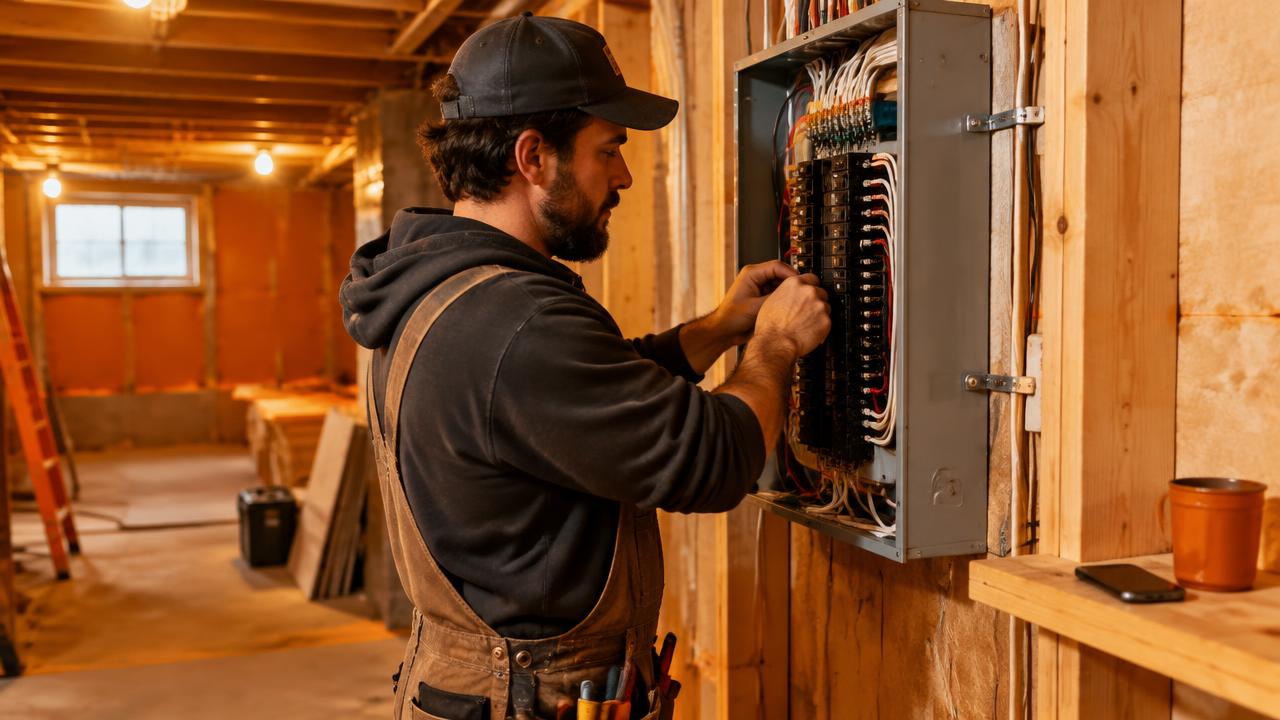
It's 10:15 a.m. You're in the attic of a bungalow in Laval, headlamp on, pulling wire for a new kitchen circuit. Your phone buzzes in your pocket. Then again. By the time you climb down the ladder, take off your gloves and look at the screen, the call is over. No message, just an unknown number. If you're an electrician, this probably sounds familiar. Missed calls come with the trade: you work with your hands, often in places where picking up is impossible or downright unsafe. It's not a lack of professionalism. The real question is: what happens to that customer once the phone stops ringing? This guide offers practical ways to stay connected without sacrificing your focus or your safety.
Why Electricians Miss So Many Calls
An electrician's work demands full attention. When you're in a panel, making a splice or checking a ground, the last thing you should do is pull out your phone. Safety comes first, and that's exactly how it should be.
Add to that the realities of the field: basements with weak cell signal, the noise of drills and saws on construction sites, work gloves, driving between customers. Not to mention the days when you're working alone and nobody else can answer for you.
The result: several calls a day can go unanswered, especially during busy periods. That's normal, and it doesn't mean you're running your business poorly. It simply means your phone needs a little help when your hands are busy elsewhere.
What Happens on the Customer's Side
Put yourself in the caller's shoes for a moment. They might have a breaker that keeps tripping, an outlet that feels hot, plans for an EV charger for their new electric car, or a basement renovation waiting for its electrician. In many of these cases, there's some urgency, or at least a desire to get things sorted quickly.
When they reach voicemail, a few things can happen. Some people leave a detailed message and wait patiently. But many others hang up without a word and simply move on to the next name in their Google search or on the list a neighbour gave them. It's nothing personal: they're looking for someone who can help them now.
So the challenge isn't to answer every call on the spot, which is impossible on a work site. The challenge is to let the customer know quickly that their request was received and won't fall through the cracks.
Running the Numbers for Your Own Business
Rather than relying on generic figures, take five minutes to do your own math. It's the best way to know whether missed calls are a real issue for you. Start by looking at your phone's call history for a typical week and count the missed calls from numbers you don't recognize.
Here's an example calculation, just to illustrate the method. If you miss 5 calls from new customers per week, and only 1 of those people ends up hiring a competitor, with an average job worth $800, that's $800 a week slipping away. Over a 40-week season, that adds up to $32,000. Your numbers will be different, but the exercise gives you an order of magnitude that's your own.
- Count your missed calls from unknown numbers for one week.
- Estimate how many of those people never called back.
- Estimate the average value of a job (small service call, new circuit, EV charger, full renovation).
- Multiply the number of lost customers by the average job value.
- Project the result over a full season to see the whole picture.
The Limits of Voicemail for Electricians
Voicemail has long been the default solution. It still has its place, but it also has its limits. First, it puts all the work on the customer: they have to take the time to leave a clear message with their name, address and a description of the problem. Many people don't like talking to a machine and would rather hang up.
It also creates work on your end. At the end of the day, you have to listen to each message, write down the details, then call customers back one by one, and they don't always pick up either. You often end up playing phone tag for days.
Texting changes that dynamic. It lets customers write to you when it suits them, and lets you reply between tasks, on a break or in the truck before heading out again. Nobody needs to be available at the same moment for the conversation to move forward.
Automatic Text After a Missed Call: How It Works
The idea is simple. When you can't answer, your line forwards the call using conditional call forwarding, a feature offered by most phone providers. Within seconds, the customer receives a text message sent from your business number, the very number they just dialled.
The message confirms that you saw their call, that you're busy on a job right now, and invites them to describe what they need by text. While you safely finish your connection, the customer is already explaining the situation. When you pick up your phone again, you have all the details in front of you.
That's exactly what Alloia does: an automatic text after every missed call, sent from your current number, then the rest of the conversation by text in a single inbox. You don't need to change your number or redo your business cards or truck lettering. The tool doesn't replace anyone: you're the one who answers the customer, simply when you're able to.
Sample Texts for Electricians
A good automatic text should be short, warm and useful. It should reassure the customer and help them give you the right information from the start. Here are a few examples you can adapt to your own style and business.
Always keep a human tone and avoid promises you can't keep, such as a callback time that's too short on your busiest days. It's better to announce a realistic timeline and stick to it.
- General: "Hi, this is [Name] from [Business] Electric. I'm on a job right now and couldn't pick up. Could you text me a quick description of what you need? I'll get back to you as soon as I can."
- For a quote: "Thanks for calling! To prepare your quote, could you tell me the type of work (new circuit, panel, EV charger, renovation) and your city?"
- With a safety reminder: "I'm on a service call and will get back to you shortly. If you see smoke or sparks, or smell burning, leave the building and call 911."
- After hours: "Good evening, our office is closed for the day. Describe what you need by text and we'll reply tomorrow morning."
- With a photo: "Thanks for calling! If you can, send me a photo of your electrical panel or the installation in question. It'll help me advise you better."
Sorting Requests by Text Without Leaving the Site
One of the big advantages of texting is that it lets you prioritize requests at a glance. Someone writing that their main breaker won't reset doesn't have the same urgency as someone who wants pot lights added in their living room next month.
To make that sorting effective, ask every new customer the same few questions. You'll get more complete requests and be able to plan your schedule more realistically, without having to call back just to get the basic details.
- What type of work or problem is it?
- Is it a house, a condo, a commercial space or new construction?
- What city or neighbourhood is the location in?
- Is there an emergency (power loss, burning smell, hot outlet)?
- Can you send me a photo of the installation or the panel?
- What is your availability for a visit?
Best Practices for Staying Professional by Text
Texting is a more informal channel than email, but it's still a professional tool. A few simple habits will help you earn trust from the very first exchange and stand out from competitors.
Keep in mind that in Quebec, more and more customers check that an electrical contractor holds a valid licence. That licence is issued by the Corporation des maîtres électriciens du Québec (CMEQ) and can be checked in the Régie du bâtiment du Québec (RBQ) registry. Including your licence number in your signature or in a follow-up message is a small touch that reassures people.
- Always introduce yourself with your name and your business name.
- Write in complete sentences, without overly casual abbreviations.
- Reply within a reasonable time, ideally the same day.
- Never give risky technical instructions by text: steer the customer toward safety and an on-site visit.
- Confirm the visit time and address in writing to avoid misunderstandings.
- Respect unsubscribe requests: if a customer texts STOP, you stop texting them.
Organizing Your Day Around Calls and Texts
Texting is no help if it has you checking your phone every two minutes. The idea is to give you back control of your time. Many electricians find it handy to set aside short, fixed windows to reply to messages: at the morning break, at lunch, between customers and at the end of the day.
If you work with a team, be clear about who handles new requests. Someone in the office, or a spouse who helps with the admin side, can follow conversations while the electricians are in the field. With a single inbox, everyone sees the same history and nobody replies twice to the same customer.
Finally, go easy on yourself. You'll never answer every call live, and that's not the goal. The goal is for every customer to get a reply and know their request is in good hands.
FAQ: Common Questions from Electricians
Do I need to change my phone number? No. The automatic text is sent from your current number. Your customers keep dialling the same number they already know, the one on your truck and business cards.
Will my customers find it impersonal? Quite the opposite: most appreciate getting a quick reply rather than waiting with no news. A well-written message signed with your name comes across as serious. And you're the one who takes over the rest of the conversation.
What if a customer has an emergency? Your automatic text can include a simple safety reminder, such as leaving the building and calling 911 if there's smoke, sparks or a burning smell. You can then call urgent requests back first.
Is it complicated to set up? Conditional call forwarding can usually be activated in a few minutes with a code on your phone or through your provider. Once it's on, everything happens automatically in the background.
What if I do answer the call? Nothing changes: if you pick up, the call goes ahead as usual. The text is only sent when the call couldn't be answered.
Can customers calling from a landline receive the text? Generally, no. In that case, the call stays in your history and the best thing to do is call the person back as soon as you can.